Is your strategy driven… or imposed?

In an era where every company is seeking to transform itself, the real question is no longer “how to digitize?” but “who orchestrates the transformation in an aligned, coherent and sustainable manner?”
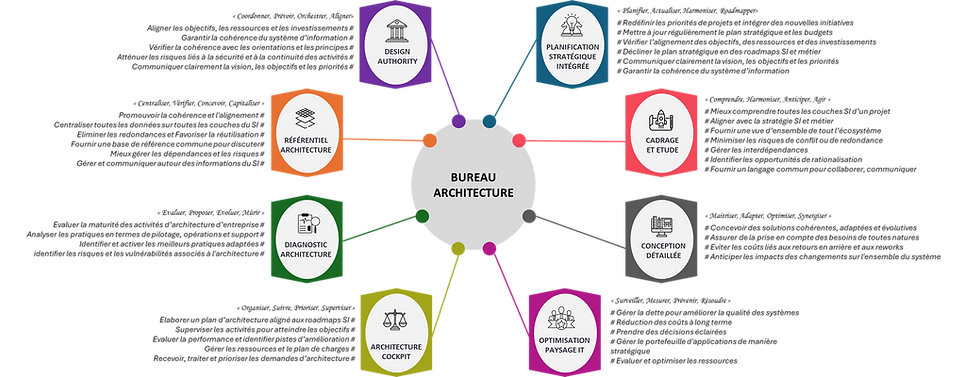
This is where the Enterprise Architect comes in - not as just another technician , but as the strategic conductor capable of linking the business vision to its operational implementation, from the Master Plan to the roadmaps by domain and by product.

Why start with him?
A Master Plan is not a list of projects. It is a coherent translation of the business strategy into an IT vision. The Enterprise Architect is the only profile that speaks both languages fluently: business and IT .
It captures the strategic needs of business departments.
It translates them across all layers of the information system (business, data, applications, infrastructure).
It ensures consistency between business priorities and technological projects .
It thus ensures that the IT strategy does not become a pile of solutions but a faithful reflection of business objectives .
Plan the vision, but also structure it
The Architect doesn't just create a PowerPoint vision statement. He structures the transformation with robust tools such as:
The Business Capability Map : to identify critical business areas, where to invest in IT.
The Application Capability Map : to understand which applications actually support the strategy.
These two spinal columns allow:
✅ to avoid blind spots
✅ to prioritize investments
✅ to ensure consistency between roadmap, budget and resources
✅ to integrate obsolescence management as a strategic lever
From strategic management to controlled execution
Once the vision is established, the Architect takes action:
It breaks down the Master Plan into concrete roadmaps , by domain and by product.
It produces a realistic budget estimate based on detailed knowledge of dependencies, risks and internal capacities.
It aligns business and IT roadmaps for smooth execution.
He is also the guarantor of the project portfolio :
By redefining priorities at each budget cycle
By integrating new initiatives without misaligning the overall plan
By anticipating resource drifts or conflicts
And above all, it avoids illusions: no strategy without consistency of execution .
A key role in risk and value control
The Enterprise Architect also plays a central role in:
Cost control (avoiding duplication, anticipating technological dead ends)
Reducing the risks of non-compliance or obsolescence
Accelerating implementation through better visibility into dependencies and feasibility
Controlled adoption of innovation (AI, cloud, automation), only where it creates value
The strategic partner of the CEO, the CIO and the business lines
A good Enterprise Architect is not just a technical expert. They are a strategic sparring partner , capable of:
Provide a shared vision of transformation
Building a common language between IT, business and top management
Act as a lucid conductor , ensuring that each initiative fits into an overall direction
Conclusion
A strategy without Enterprise Architecture is doomed to dispersion.
A transformation without alignment is doomed to failure.
A system without coherence is doomed to obsolescence.
What if now was the time to transform your vision… into masterful execution?


Comments